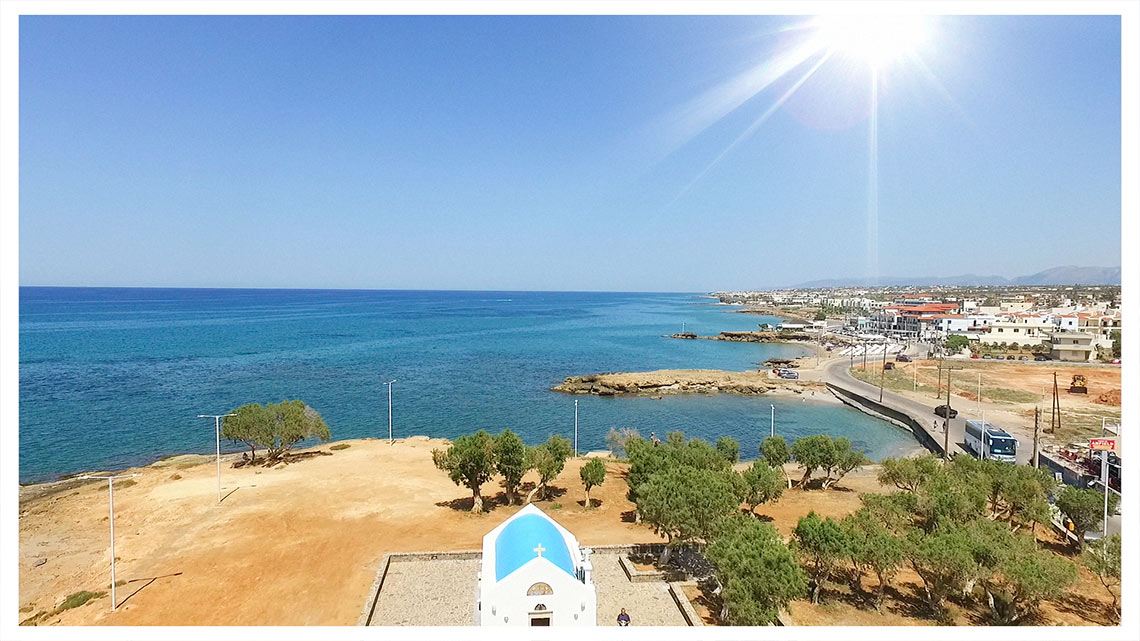

Gouves, about 10 km east of Heraklion, is, as are many other coastal settlements in Greece, a split village. That is, there is an upper village, Ano Gouves, and a lower village on the coast, Kato Gouves, which sits on a 18 kilometer-long, relatively straight east-west portion of Crete's northern coast. Kato Gouves is tucked in between Gournes just to the west, and Analipsi to the east. Topographically, these coastal tourist villages are fairly similar to one another.
Visitors to Gouves have a choice of staying in the upper village, just a couple km inland from the sea and about a hundred meters higher, or in one of the resort hotels, apartments or rooms in the lower village, near the sea. Visitors to Ano Gouves have frequent shuttle service to take them down to the beach and back, but really it's only about a 15-minute walk, so you can get a little exercise in with the sea and sand experience of Kato Gouves. Plus you'll probably find cheaper accomodations in the upper village.
Gouves is just a few minutes from Heraklion, and its various attractions, including the Venetian port and the palace at Knossos. It is also just a few minutes, in the opposite (west) direction, from Grete's largest resort area at Hersonissos, with its vibrant night life.
There are a lot of options for fun at the beach in Kato Gouves: there are paddle boats and jet skis for rent, scuba lessons to be taken, snorkeling to be done, paragliding or waterskiing to learn, and just splashing around in the azure waters, after which you can oil up and dive deeply into the latest bestseller while the sun slowly turns you the color of bronze.
Ano Gouves offers a relaxing central square where you can mingle with the locals and enjoy a coffee in the shade, watch the life of a traditional village unfold around you, walk the twisty, narrow streets and look at the old houses, and visit the churches.
To the southeast of Ano Gouves there is the monastery of Saint John Theologos (John the Theologian). When the Ottoman Turks occupied Crete, the monastery was a gathering place for freedom fighters, and it also hosted a secret school, one of many throughout Greece during Ottoman rule which helped keep the language, culture, and history of Greece fresh in the minds of boys and girls growing up in an occupied country. Such activities were strictly forbidden, and, in July of 1896, the monastery was destroyed by the Turks, and the people of Ano Gouves were put to the sword.
Another couple kilometers inland (south) from Ano Gouves is the village of Skotino, home to the Skotino ("Dark") Cave. Crete has upwards of a hundred caves, and this one, at 160 meters deep and 30 meters wide, is one of the largest. Another name for the cave is Agia Paraskevi, named for the church of that name built on top of it. The cave was explored by archeologists, and artifacts pointing to its use as a the site of worship of a female Minoan deity, Britomartis, have been found. Britomartis was the goddess of the hunt. During classical Greek (5th-4th centuries BC) and Hellenistic (3rd century BC-birth of Christ) times, worship was transferred to Artemis, the Greek version of Britomartis, while in Roman times Diana, the Roman version of the same deity, was worshipped there. Interestingly, all 4 personages, Britomartis, Artemis, Diana, and Agia Paraskevi, were virgins.
Also close to Ano Gouves, at a few km northeast, near Kokkino Hani, is a Minoan-era villa, which was about 1000 square meters (1/4 acre), and was possibly the home of a high priest. Artifacts from the villa are on display at the Heraklion Archeological Museum.
Gouves is an excellent location for everything Crete has to offer: a traditional village, a classic seaside experience, a cave to explore, and Minoan ruins to visit, all within a few kilometers of each other.
What to do in Gouves
Enjoy swimming at the many beaches in the Gouves area. Don't forget that Gouves is close to many other seaside resort and villages, such as Kokkini Hani, Gournes, Analipsis, Anissaras, Hersonissos, Stalis and Malia and others further east, so there are unlimited beaches to choose from.
Try sea sports: waterskiing, pedalo, canoe, paragliding, banana boat, etc.
Walk to the seaside church of Saints Constantine and Helen, in the small pine grove. If you come on Sunday morning you can attend Mass, and if you are lucky there may be a wedding or a christening, usually on Saturday afternoon.
Don't miss the large aquarium in nearby Gournes, the famous Crete Aquarium. Gournes is just half an hour's walk from Gouves. Take the coast road to the east and continue past the campsite. At some point you need to turn left and cross the former American Base, which may also interest you as a historical sight.
If you want to make your children happy, give them a day of fun and games at the Anopolis Water Park or the two Hersonissos Water Parks.
A drive to the top of Mt. Ederi should be "high" on your list of things to do. The road is steep, but well-paved, as it was once a part of the military facility at neighbouring Gournes. In fact, although long abandoned, the huge twin radar "ears" are still there, prompting locals to refer to the area as "Mickey Mouse Mountain." Whatever you call it, the view from its zenith is breathtaking.
As previously mentioned, the old village of Pano Gouves is a must-visit for anyone staying in the area, and there are several interesting churches nearby, including: Agios Georgios (Saint George), Agios Ioannis (St. John) and Panayia (dedicated to the birth of Our Lady). In the small square of Kato Gouves you will find traditional kafeneia and a taverna, while in the narrow alleys you will discover many old houses, some restored and others ruined.
Several kilometres further up from Pano Gouves, is the quaint village of Skotino, and its nearby Skotino cave, which is among the largest in Crete. It has a depth of 160 meters, and it is on four levels. Like many other caves, it appears to have had some religious importance, and some people even believe this was the labyrinth of the legendary Minotaur, which is doubtful. Minotaur or not, this site should not be missed.
Knossos, the great Minoan Palace, is only 20 kilometres from Gouves and there are frequent buses during the summer. There is also much to see on a walk around Heraklion, such as the Archaeological Museum of Heraklion, the Historical Museum of Crete and the Natural History Museum.
explorecrete.com

